


Google NeXT 2023 ya comenzó, puedes ver aquí la conferencia
Experience Google Cloud Next ’23Google Cloud Next ’23 is back - in person on August 29-31 in San Francisco! Connect
Aug 2, 2023
Just a minute or less

Qunnect Inc., a Brooklyn-based company, has successfully operated a prototype quantum internet network under the streets of New York City for 15 continuous days. This achievement marks a significant step towards the development of a practical and stable quantum internet. The network, called GothamQ, utilizes polarization-entangled photons and
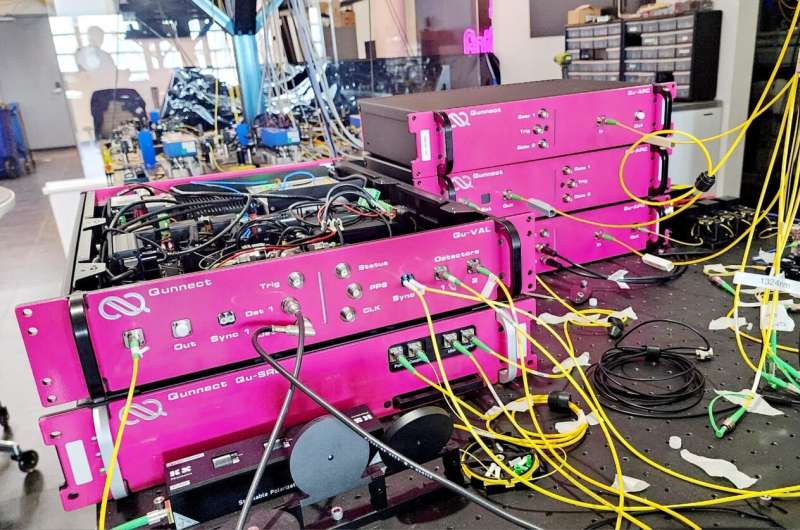
Qunnect's Qu-Val equipment, consisting of an entanglement source, Automated Polarization Compensators and measuring device. Credit: Mehdi Namazi of Qunnect, fetched from Phys.org
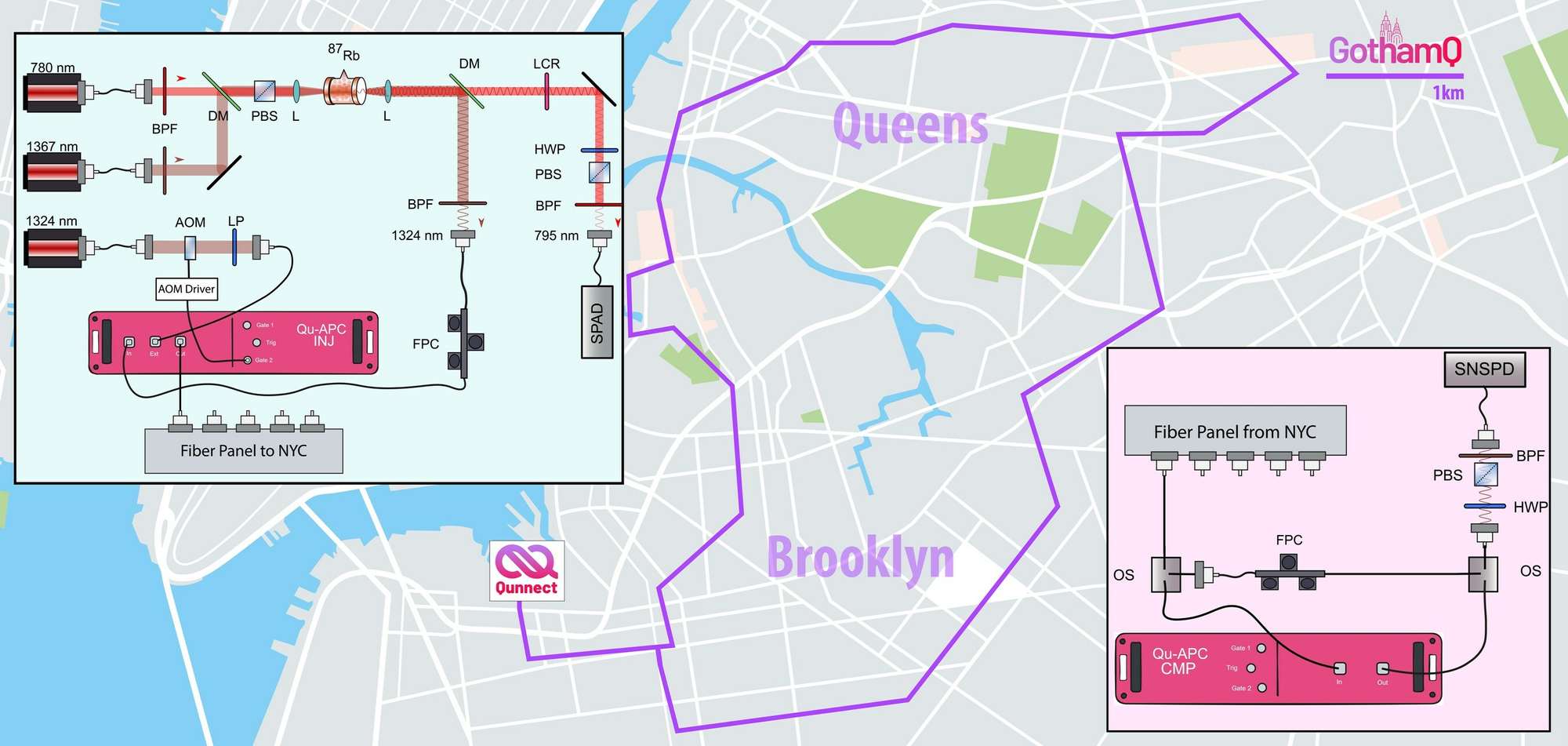
Qunnect Inc., a Brooklyn-based company, has successfully operated a prototype quantum internet network under the streets of New York City for 15 continuous days. This achievement marks a significant step towards the development of a practical and stable quantum internet. The network, called GothamQ, utilizes polarization-entangled photons and features automated polarization compensation (APC) devices to mitigate the effects of fiber environment disturbances. The results, published in PRX Quantum, demonstrate the feasibility of long-term, stable entanglement distribution over metropolitan fiber networks.
The development of quantum networks faces a major hurdle: the fragility of entangled states in fiber cables. Entanglement, a fundamental quantum phenomenon, is essential for secure communication and powerful computation. However, entangled photons are highly susceptible to disturbances caused by vibrations, bending, and temperature fluctuations within fiber cables. These disturbances can lead to rapid degradation of entanglement, making it difficult to maintain stable connections over long distances.
Qunnect's GothamQ network tackles this challenge head-on. The network utilizes a leased 34-kilometer-long fiber circuit, operating for 15 continuous days with an uptime of 99.84%. The network transmits polarization-entangled photon pairs at a rate of about 20,000 per second, achieving a compensation fidelity of 99%. This means that the entangled photons remain in their desired state with high accuracy, even after traveling through the fiber network.
To achieve this remarkable stability, Qunnect has developed automated polarization compensation (APC) devices. These devices continuously monitor and correct the polarization of the entangled photons as they travel through the fiber. By sending classical photon pairs with known polarizations, the APCs can measure and compensate for any polarization drift caused by environmental disturbances.
The GothamQ demonstration is significant for several reasons:
Qunnect's GothamQ network represents a major step towards the realization of a practical and scalable quantum internet. The company's success in overcoming the challenges of entanglement distribution over long distances paves the way for future advancements in quantum communication, computation, and sensing.
While we can't quite simulate quantum entanglement with classical code, we can represent photon polarization and its manipulation using Python libraries like NumPy:
import numpy as np

# Define a photon as a 2D vector representing its polarization state
photon = np.array([1, 0])  # Horizontally polarized photon

# Define a polarization rotation matrix (e.g., for a 45-degree rotation)
rotation_angle = np.radians(45)
rotation_matrix = np.array([[np.cos(rotation_angle), -np.sin(rotation_angle)],
                           [np.sin(rotation_angle), np.cos(rotation_angle)]])

# Rotate the photon's polarization
rotated_photon = np.dot(rotation_matrix, photon)

print("Original photon polarization:", photon)
print("Rotated photon polarization:", rotated_photon)
# Output:
# Original photon polarization: [1 0]
# Rotated photon polarization: [0.70710678 0.70710678]
This code snippet provides a basic illustration of how photon polarization can be represented and manipulated mathematically. In a real-world quantum network, the principles of quantum mechanics govern the behavior of entangled photons, enabling secure communication and other groundbreaking applications.
 Alexander N. Craddock

Experience Google Cloud Next ’23Google Cloud Next ’23 is back - in person on August 29-31 in San Francisco! Connect

Qué significa la computación cuántica? Qué significa Phase transition? Qué es Random Circuit Sampling?