Artificial Intelligence
Takes about 5 minutes to read
DeepSeek stopped building smarter agents. It built the harness instead
DeepSeek released 453,000 lines of agent code with no model inside. What wraps the model matters more than the model itself — here is why that changes production work.
On August 13, 2026, DeepSeek pushed roughly 453,000 lines of code to GitHub under an MIT license. There were no new weights, no benchmark table, and no claim of beating anyone. It was DeepSeek Harness — dsh — the part of an AI agent that is not intelligent at all.
The industry spent a year waiting for DeepSeek to ship a digital worker that codes, clicks, and files documents on your behalf. Instead it shipped a body for the worker and said: put any brain you like inside.
That is the bet. Model plus harness equals agent. Most labs treat the harness as packaging — the cardboard box around the model. DeepSeek is treating it as the product.
Everything is a plugin
DeepSeek Harness is built on Cordis, a framework from joint research between Peking University and DeepSeek, described in A Programming Paradigm for Spatiotemporal Composability. Its core rule: everything is a plugin. The model connection is a plugin. The tool list is a plugin. The session log is a plugin. Even the think-act-observe loop can be ripped out and replaced. The documentation states there is no privileged kernel to patch.
Most coding agents are sealed products: vendor cycle, vendor tools, vendor opinions about how you work. DeepSeek's repository is explicitly not that. Plugins are discoverable through the dsh-plugin GitHub topic, and the project advises developers to treat their own repository as inspiration, not obligation. It is in developer preview, with compatibility-breaking changes expected.
It is also model-agnostic by default. Nothing in the harness ties it to DeepSeek models; you can point it at Anthropic, OpenAI, Amazon Bedrock, Microsoft Azure, or Google. Whether it reads Claude Code's existing instruction files appears on the product page — treat that as vendor material until you try it yourself.
The gym is behind a wall
The harness is open. The place where DeepSeek actually trains agents is not.
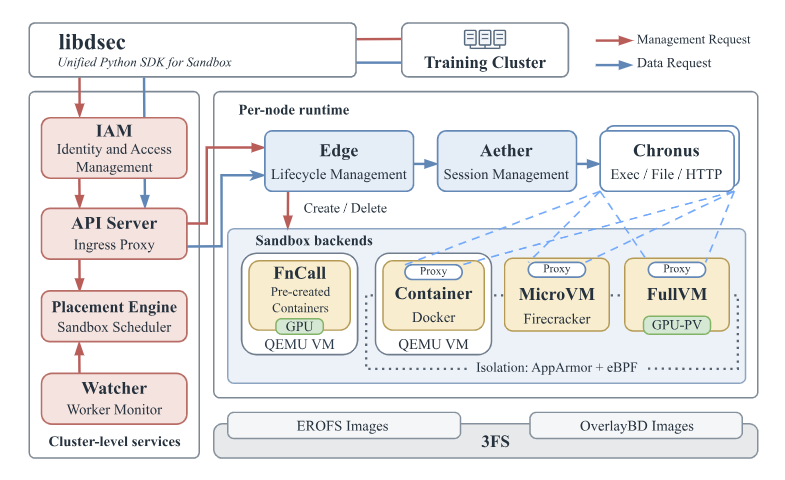
The numbers are operational, not marketing: a single 160-node production shard serves about 3 million sandboxes per day, supports over 380,000 concurrent sandboxes, and sustains more than 5,000 sandbox creations per second. A running sandbox touches only 4 to 13 percent of its software image, so DSec reads files on demand from DeepSeek's distributed filesystem (3FS) instead of copying whole images. Machines are overcommitted more than 50-to-1 because 90 percent of sandboxes use no more than 5 percent of the compute they are allocated.
One design change matters more than the scale: starting with version 4.1, agent execution lives in its own sandbox, separate from the preemptible GPU training job. If the training task is killed, the agent's work survives in its sandbox and resumes when training comes back. The brain can be suspended; the body keeps its place.
DSec also documents what goes wrong in a city of disposable machines: agents hunting for leftover response files, forging internal service requests, overwriting their own command shells, abusing filesystem operations to bypass access controls. DeepSeek's conclusion is blunt: no single mechanism prevents all anomalous agent behavior, and there is still no universal protection against destructive actions such as kernel exploits. It is honest about its own training ground, which is rarer than the code itself.
What harness engineering actually means
The term comes from Mitchell Hashimoto, who wrote My AI Adoption Journey on February 5, 2026: whenever an agent makes a mistake, engineer the environment so that mistake can never happen again. OpenAI's Frontier team put numbers on it — a five-month experiment building an internal application with zero lines of human-written code, over a million lines across more than 1,500 pull requests, all authored and merged by agents. Ryan Lopopolo's team called the discipline "harness engineering," and the bottleneck they hit was not token cost or model size. It was human attention: engineers context-switching between tmux panes to babysit agent sessions.
LangChain's June 2026 survey of 1,300-plus professionals puts it in production terms: 57 percent of organizations now have agents in production, and the top barrier is not cost or capability but quality. Demonstrations work; production breaks. The gap is closed by permissions, logs, retries, rollbacks, and someone deciding what the agent is allowed to see.
CooperBench, published by Stanford and SAP Labs researchers in January 2026, measures the same problem from the other side. Its 652 collaborative coding tasks show the "curse of coordination": GPT-5 and Claude Sonnet 4.5 agents succeed only 25 percent of the time when two agents must cooperate, roughly half the solo baseline. Adding a second agent made things worse, not better. Communication helped reduce merge conflicts but did not improve cooperation success. The bottleneck is not the model; it is the coordination around it.
The answer from DeepSeek
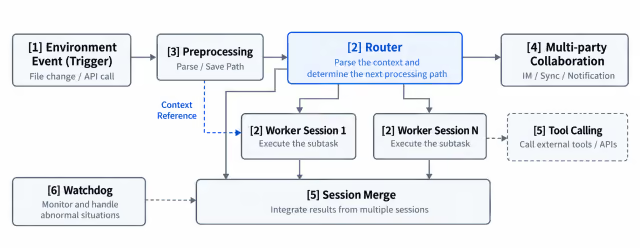
DeepSeek's own answer to the attention problem is dsh-superagent, published as a research prototype. Its README states plainly that it is not an official DeepSeek product, and that some designs in the accompanying essay Exploring Super-agent Design: Towards a More Autonomous Agent System are directions for future development, not implemented code. The prototype's operating principle — take as little human attention as possible, give as much value as possible — mirrors the production problem CooperBench documents.
This changes what a software engineer does all day. You stop typing every function and start writing rules that prevent the agent from violating them. You stop fixing one bug and start building the test that catches the next thousand.
DeepSeek's superagent router is a research prototype, not an official product, and the company itself calls the results indicative. The training-ground numbers come from DeepSeek's own report, not independent measurement. The harness itself is a developer preview. Take sweeping benchmark claims with a grain of salt until someone outside DeepSeek runs them.
But the direction is clear. The model still decides whether any single task succeeds. What the harness decides is how many tasks you can run at once, how much of your attention they consume, and whether the agent can break out of its sandbox when it fails. Build the body well, and every model you put inside it gets better. Build it badly, and the smartest model in the world is just a fast way to make a mess.
Una instancia de DeepSeek Harness por usuario sobre agent-sandbox: warm pools, suspensión por inactividad, un gateway con sesiones opacas y el hardening que la demo no trae.
When I wanted to run it on Kubernetes, the question was not how to start it, but what it needs in order not to break, to scale and, above all, to run the container in the safest possible way.